


11/09/2026
Beyond the Degree: What Georgian Graduates Need for Tomorrow's Labour Market
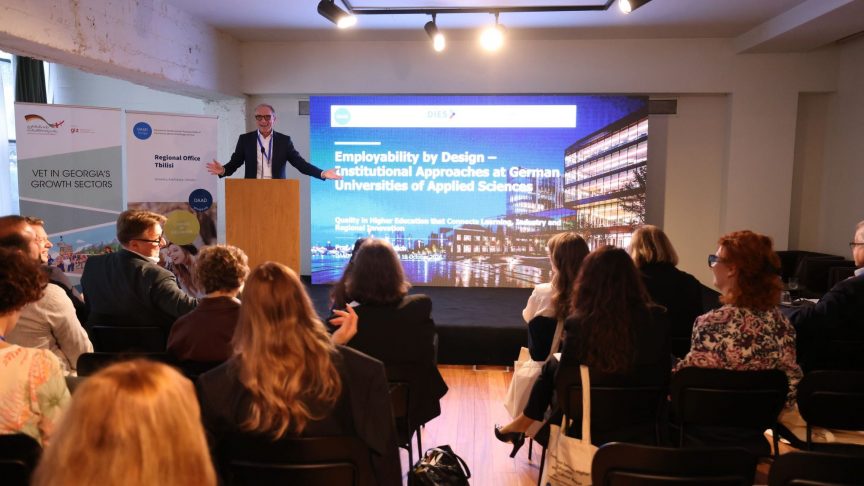
The conference was jointly organised by the DAAD Regional Office Tbilisi and GIZ Georgia. Dr. Thomas Lichtenberg (ASIIN e.V.) moderated both days.
The programme combined keynotes from German and Georgian experts, two panel discussions and two rounds of parallel workshops. German experience served as a source of design principles, not as a blueprint: the aim was to help Georgian institutions develop their own solutions.
Strong interest from across Georgian higher education
Interest in the conference clearly exceeded expectations: registrations were well above the planned capacity, and more participants attended than originally calculated. The audience reflected the diversity of the Georgian higher education landscape:
- Institutions: The large majority came from universities – from established state universities such as Ivane Javakhishvili Tbilisi State University and Ilia State University to smaller, specialised and private institutions, including universities outside Tbilisi.
- Functions: Rectors, vice-rectors and deans took part alongside quality assurance and accreditation staff, programme managers, career centre heads and teaching staff. Quality assurance was particularly well represented.
- Disciplines: Business and economics as well as medicine were the strongest fields, followed by the social sciences and education.
- Further participants: Representatives of international organisations and donors as well as of the private sector completed the picture.
Day 1: Employability as an institutional task
In his keynote “Employability by Design”, Prof. Dr.-Ing. Klaus Kreulich, Vice President for Innovation and Quality in Higher Education at Hochschule München University of Applied Sciences, argued that employability cannot be achieved through isolated practical components. It must be embedded in learning objectives, curricula, teaching, assessment and university structures. His guiding idea: “Practice provides the problem. Academic rigour shapes how it is addressed.” Examples from Munich, such as an interdisciplinary student project with Lufthansa Consulting, showed how teaching partnerships with companies can grow step by step into strategic cooperation.
Prof. Dr. Irine Darchia, Higher Education and Quality Assurance Expert at Tbilisi State University, looked at the Georgian situation. She described a non-diversified labour market, skills mismatches and many graduates working below their qualification level. Although Georgian quality assurance standards require labour market research and stakeholder involvement, they are often implemented only formally. Her suggestions ranged from competence-based curricula and flexible internship formats to closer links between vocational and higher education – and, above all, more dialogue. Using classics as an example, she showed how internships with museums, archives and NGOs can develop employable skills also in the humanities.
In the afternoon, participants worked in three parallel workshops:
- Strengthening Employability: A Maturity Framework for Developing Degree Programmes (Prof. Dr.-Ing. Klaus Kreulich)
- Integration of Theory and Practice (Prof. Kay Wilding, Baden-Württemberg Cooperative State University, DHBW)
- Bridging the Gap – How Georgian Universities Can Better Serve Economy and Society (Dr. Niclas Rüffer, GIZ, and Tornike Jobava, Deputy Chairman of Georgia’s Innovation and Technology Agency, GITA)
The panel “Employability in Practice: Structures, Standards and Partnerships” brought together Prof. Kreulich, Prof. Nino Enukidze (Rector, Business and Technology University), Assoc. Prof. Rusudan Sanadze (Tbilisi State University) and David Zgudadze (Country Manager Georgia and Armenia, Mastercard). Mr Zgudadze provided valuable insights into the expectations and needs of Georgian employers. A major topic of the discussion was how artificial intelligence is changing university teaching and making the question of employability even more pressing. All panellists shared their advice: Prof. Enukidze reported on the experience of the Business and Technology University, while Prof. Sanadze and Prof. Kreulich stressed that a clear focus on learning outcomes is now more important than ever. The day ended with a networking dinner.
Day 2: From cooperation to co-creation
After a recap of the first day, Prof. Kay Wilding, former Dean of Studies for Electrical Engineering at DHBW, presented the German dual study model in his keynote “Dual by Design”. Students alternate every three months between theory at the university and practice in a partner company. Eight out of ten DHBW graduates receive a job offer by the time they graduate – a strong argument for close cooperation between universities and employers. The dual study model met with particularly lively interest from the Georgian audience, and Prof. Wilding answered numerous questions on how such programmes work in practice.
Dr. Niclas Rüffer, Project Director of the GIZ project DT4SME in Tbilisi, gave an overview of knowledge and technology transfer in Germany and other central European countries. Using the Center for SME Research and Entrepreneurship at the University of Mannheim as an example, he showed how applied research, direct cooperation with SMEs, policy advice and start-up support work together. He highlighted technology transfer offices as key brokers between science and business.
The panel “From Cooperation to Co-Creation: Making University–Business Partnerships Work” with Prof. Wilding, Dr. Rüffer and Tornike Jobava (Deputy Chairman, GITA) continued this discussion. Mr Jobava encouraged participants to make even more use of GITA’s support for universities, start-ups and spin-offs.
In the second workshop round, participants switched groups. Two workshops were repeated; the DHBW workshop took up a new topic:
- Understanding Competencies and Needs: Which subject-specific, methodological and social competencies do graduates need today and in the future – and how do the expectations of universities and companies differ?
The maturity framework workshop was a particular highlight. It covers six quality dimensions – from regional and industry relevance to graduation projects linked to enterprise needs. In a World Café, participants applied it to real degree programmes from their own universities and agreed on strengths, development priorities and realistic first steps.
Results and outlook
The conference met with a very positive response. Participants followed the presentations with great interest and contributed many questions and comments. Key results:
- Practical work: In all three workshops, participants worked intensively on real examples from Georgian universities.
- Exchange across institutions: Many participants valued the opportunity to talk to colleagues from other universities – especially between large state universities and smaller, specialised or private institutions.
- Motivation for change: Many participants now plan to further develop their degree programmes with a stronger, more stuctured view to employability or to strengthen structures such as technology transfer offices.
- Awareness of employers’ needs: The conference raised awareness of the expectations of the Georgian economy and of existing support offers such as those of GITA.
DAAD and GIZ plan to build on these results and to offer further information and networking formats on cooperation between higher education and the labour market.
Downloads:
DIES-Dialogue Conference Programme [PDF 360.06 KB]
DIES-Dialogue Conference Programme schedule [PDF 399.25 KB]
Keynote: Prof. Kay Wilding – Dual by Design: Cooperative Education in Higher Education [PDF 2.50 MB]
Keynote: Dr. Niclas Rüffer – Knowledge and Technology Transfer [PDF 427.70 KB]
Workshop: Strengthening Employability – A Maturity Framework for Degree Programmes [PDF 347.53 KB]
Foto gallery


